


.png)
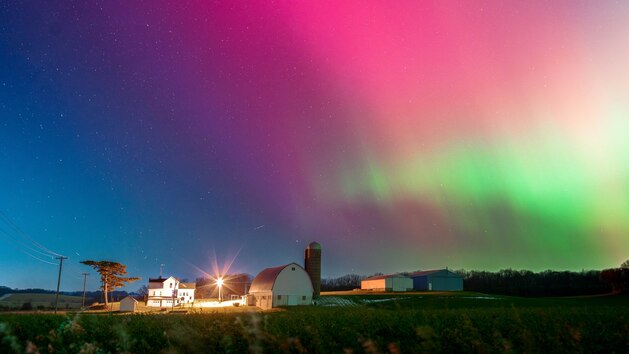
It's been a busy week for the sun, and aurora watchers in some northern and upper Midwest states looking for a glimpse of the famed colorful sky could benefit from enhanced solar activity Thursday night into Friday morning, Oct. 9.
On Tuesday, a coronal mass ejection (CME), a massive burst of charged particles embedded in a magnetic field, departed the sun bound for Earth.
The ejection is associated with a moderate solar flare.
The National Oceanic and Atmospheric Administration's Space Weather Prediction Center (SWPC) has issued a moderate Geomagnetic Storm Watch beginning Thursday evening into Friday, as a result of the CME.
According to NOAA, a geomagnetic storm is "a major disturbance of Earth's magnetosphere that occurs when there is a very efficient exchange of energy from the solar wind into the space environment surrounding Earth."
While the agency says much of the activity will be minor, there could be periods of moderate storm activity. The UK Met Office says there's even a slight chance of strong G3 levels.
The SWPC says the solar activity could create minor impacts to our technological infrastructure, but it's "mainly manageable."
On the bright side, the aurora borealis, which appears in the night sky when electrically charged particles from the sun hit Earth's atmosphere, could be visible in areas that don't normally experience it.
"Aurora may be seen as low as New York to Wisconsin to Washington state," SWPC said in its alert.
Another CME linked to a smaller solar flare is also headed toward Earth but is only expected to deliver a "glancing blow" over the weekend, according to the UK Met Office.
All this solar weather will keep conditions unsettled to active over the next few days. But whether you'll be able to see the auroras depends on exactly when the CME arrives, the cloud cover and the magnetic orientation of the CME's magnetic field.
When geomagnetic activity becomes stronger, the aurora can sometimes be seen farther south than usual.
Copyright © 2026, ABC Audio. All rights reserved.

