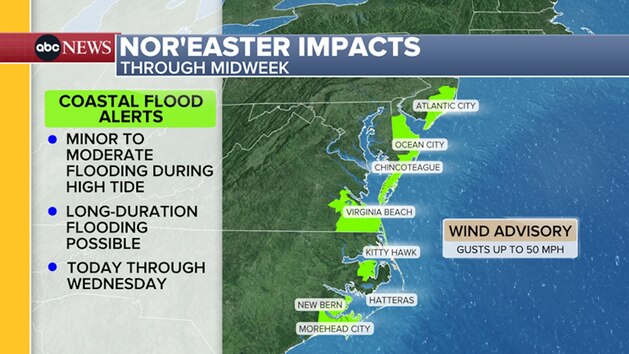
An October nor'easter aimed at the Mid-Atlantic coast is expected to bring strong winds and large breaking waves from North Carolina to New Jersey through the middle of this week. (ABC News)
A slow-moving October nor'easter aimed at the Mid-Atlantic seaboard is expected to produce days of high winds, life-threatening rip currents, beach erosion and coastal flooding from North Carolina up to New Jersey.
Coastal flood alerts are in effect from Monday through Tuesday in Virginia, Maryland, New Jersey, North Carolina and Delaware.
The long-duration storm is expected to stretch into the middle of this week. The storm is expected to mainly be a wind and wave event, with the bulk of the rain remaining offshore.
Minor to moderate coastal flooding is likely, especially at high tides, in multiple cities including Atlantic City and Virginia Beach.
Wind advisories have also been issued for portions of coastal Virginia and North Carolina, including Virginia Beach and North Carolina's Northern Outer Banks, Hatteras Island and Ocracoke Island. Sustained northeast winds in these areas are expected to be 25-35 mph, with gusts of up to 50 mph.
Large breaking waves of 9 to 12 feet are possible for parts of the Outer Banks and along the Delmarva Peninsula from Virginia to Delaware through late early Thursday.
Weather conditions are already deteriorating in the Outer Banks and other barrier islands off the North Carolina coast.
Mandatory evacuation orders have been issued for Hatteras Island in North Carolina, creating heavy traffic on Highway 12, according to Dare County, North Carolina, Emergency Management.
"Visitors are not permitted to enter Hatteras Island at this time and will not be allowed to return until the storm system has passed and conditions along N.C. Highway 12 have improved to the point that the roadway is no longer threatened by ocean overwash," the Dare County Emergency Management said in a statement issued on Sunday.
Phobos and Deimos over the surface of Mars. Asteroids satellites of the red planet in space. Close-up of Mars with the Moons. (Nazarii Neshcherenskyi/Getty Images)
We've learned a lot about Mars since Mariner 4 took the first close-up photos of the red planet in 1965. Since that mission, orbiters, landers and rovers have explored the Martian surface, expanding our understanding of the planet.
But we know very little about Mars' moons, Phobos and Deimos, including how they formed.
Japan Aerospace Exploration Agency's (JAXA) Martian Moons eXploration (MMX) mission could unlock some of the moons' mysteries and help scientists better understand Mars' history and our own planet.
"MMX will be the first spacecraft ever to return to Earth from the Mars system," said Tom Statler, NASA's MMX program executive and scientist, during a pre-launch press conference. "The Phobos samples will be historic. The first samples from a moon other than Earth's moon," he added.
Scheduled to lift off as early as Monday, Oct. 19, at 3:41 p.m. EDT from the JAXA Tanegashima Space Center, MMX is a first-of-its-kind mission that will not only study the moons of Mars but bring samples back to Earth.
Led by JAXA in partnership with NASA, the European Space Agency, and the French and German space agencies, the orbiter will arrive at Mars in August 2027, then turn its attention to Phobos a month later. NASA says MMX won’t technically orbit the moon; instead, it will use a "quasi-satellite orbit," circling Mars in a path that keeps it near Phobos.
MMX is equipped with 13 scientific instruments, including NASA’s MEGANE instrument, which, the agency says, “will let MMX ‘see’ the elemental composition of the moon’s surface and help peg the likely origin of the moon.”
After studying Phobos from space, MMX will then attempt one or two landings on the Martian moon's surface. The spacecraft is expected to spend two to two and a half hours on the ground during each stop. While there, it will use a device called a Pneumatic Sampler to collect at least 10 grams of soil from Phobos. MMX will then deliver that material back to Earth in 2031, depositing it in Australia by using a capsule designed to survive re-entry into our planet's atmosphere.
"It will help us better understand Phobos and the evolution of the Mars system. The mission's science and return samples will complement decades of Mars exploration and help inform future discoveries, and perhaps even in the further future, crewed missions to the red planet," said Lindsay Hays, NASA's acting director of the Planetary Science Division.
Scientists have long speculated on the origins of Mars' moons. They may have started as asteroids that Mars pulled into its orbit. Or they could be debris remnants flung into orbit after a giant object struck the Martian surface. The challenge is that there's compelling evidence for both possibilities. By studying the samples collected on Phobos, scientists believe they can finally solve that question.
"By going to the Martian moons, studying them up close and bringing samples back to Earth we'll be able to determine whether Phobos material is more consistent with an asteroid composition or with debris created by a collision involving Mars. That's the kind of question that we need to have instruments right there at the object and have the detailed laboratory analysis of the actual material to answer," explained Statler.
Why does it matter how Mars' moons came to be? Statler said that knowing where the moons came from can reveal how the solar system, and our own planet, took shape.
"For years, we've been asking questions like, 'Well, how did water get delivered to the Earth? Did the same processes deliver water to Mars, to Venus, to Mercury? Where did organic materials come from, and so on,'" said Statler. "Understanding where Phobos and Deimos came from goes to understanding what was going on at that time and where that stuff was coming from."
The spacecraft won't land on Mars because, unlike Phobos, the red planet has an atmosphere and significantly more gravity. This makes landings and liftoffs much more challenging and would require a different kind of vehicle. But that doesn't mean the mission won't return Martian samples to Earth because of Phobos's proximity to Mars.
"That proximity to Mars means that it is conceivable that meteor impacts on Mars, large ones, can blast material up off the surface of Mars and some of that can find its way to Phobos," said Statler. "The general consensus is there is a very good chance that there is a tiny fraction of Mars material mixed in with the regolith, the soil, on the surface of Phobos."
If even a trace of Mars is mixed into the Phobos soil, it would be an unexpected bonus: a mission aimed at Mars’ moons could end up delivering a piece of Mars itself. NASA will receive at least 15% of the returned samples for the scientific community to analyze. What they'll find remains to be seen, but it could raise new questions about Mars' history and the formation of our solar system.
"It's a piece of the puzzle that will enable us to ask smarter questions about how to explore and where to explore," Statler said.
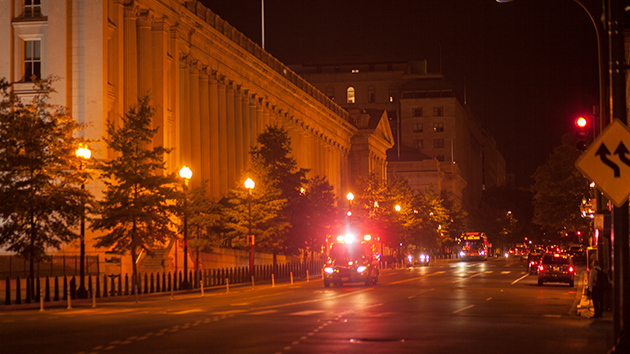
The Metropolitan Police Department in Washington said early on Monday it was investigating a late-night shooting that involved members of the National Guard, one of whom was injured.
Guard members had intervened in breaking up a fight at about 11 p.m. on Sunday night, the MPD said, adding that a person involved in that fight then allegedly began firing a weapon.
A Guard member was shot in the leg by the individual, according to D.C. police.
"National Guard immediately gave commands to that individual to put down the gun.," D.C. Interim Police Chief Jeffery W. Carroll told reporters at the scene. "That individual then pointed the weapon towards National Guard members, who returned fire to the individual."
Three Guard members returned fire, with at least one of them hitting the individual in the abdomen, Carroll said.
Both the Guard member and a the person who allegedly fired at the members are being treated in local D.C. hospitals with non-life-threatening injuries, police said. The suspect was placed under arrest, Carroll said.
The shooting occurred near the the 400 block of 8th Street SE, the force said in a statement.
An Air Force member has died from injuries he suffered on Saturday while rappelling from the ceiling of the Alamodome in San Antonio, Texas, as part of a college football pre-game ceremony honoring the Armed Forces and military veterans, authorities said.
The incident occurred just before kickoff between Navy and the University of Texas at San Antonio.
"Once the band started playing, there was a guy that fell down," witness Adrian Corey, one of more than 23,000 people who attended the game, told ABC San Antonio affiliate station KSAT.
The airman was identified as Sgt. Ian Patterson, assigned to the 6th Combat Training Squadron, Detachment 2, a spokesperson for the Nellis Air Force Base, where the airman was stationed, said in a statement. Nellis Air Force Base is located in Nevada.
He was pronounced dead at the hospital after the fall.
Witnesses said the airman was one of three service members conducting a rappelling demonstration from the Alamodome's ceiling, a drop of about 170 feet.
Corey, who recorded the incident on his cellphone, said he and other spectators noticed something was wrong when the airman, whose name has not been released, "started coming down fast."
San Antonio Fire Department spokesman Joe Arrington told ABC News that firefighters responded to the Alamodome around 7 p.m. local time after getting a call about someone falling during a pre-game event. Arrington said the individual was taken to a hospital with life-threatening injuries.
A spokesperson for the University of Texas at San Antonio said in a statement to ESPN that students who witnessed the incident are encouraged to contact the university's crisis hotline.
"Our heartfelt thoughts and prayers are with the soldier who was affected, his family and his military colleagues," the UTSA spokesperson said. "We recognize that members of our campus community may be emotionally affected by this incident and are activating wellbeing services to support our faculty, staff and students."
ABC News' Chris Barry and Matthew Acosta contributed to this report.
Two people, including a 6-year-old boy, were killed and 11 others injured after a truck drove through a youth soccer game in Wichita, Kansas, on Saturday afternoon, police said, in what officials called a "heartbreaking" incident that authorities are still investigating.
Among those injured were five children, ages 5 to 9, and five adults, ranging from a 28-year-old woman to a 68-year-old man, the Wichita Police Department said on Sunday. The injuries ranged from bruises to "extremely severe injuries."
A 61-year-old woman also experienced medical complications unrelated to traumatic injuries caused by the truck, bringing the total number of people sent to local hospitals to 11, police said.
First responders rushed to Stryker Soccer Complex after receiving multiple 911 calls around 3:25 p.m. CT, Capt. Aaron Moses of the Wichita Police Department told reporters at a press conference Saturday evening.
Police said the driver, who they identified only as a 34-year-old woman of Garden City, Kansas, stayed with the truck after the incident.
As of Sunday afternoon, no charges had been filed in the incident, according to police. The driver of the Chevrolet pickup truck involved in the incident was released from custody pending the results of toxicology testing and a mechanical examination of the vehicle.
"She has been cooperative to this point in the investigation," Moses said.
The two people killed in the incident were pronounced dead at the scene, police said. They were identified on Sunday by police as 6-year-old Cole Adrian and 35-year-old Nicholas Schafer, both of McPherson, Kansas.
These families "face an unimaginable loss ... what should have been a day of children playing soccer and families spending time together ended in tragedy," Wichita Police Chief Joe Sullivan said in a statement.
Investigators interviewed more than 30 witnesses, including the two juveniles who were inside the pickup at the time of the crash, police said on Sunday.
Moses told reporters on Saturday that one of the driver's children was playing soccer at the complex on Saturday but was not on that field at the time the incident occurred.
When police arrived at the scene, the truck was located on the west end of the field, and bystanders were helping to render aid to the injured people on the field, Moses said.
Police stressed they are still investigating and asked the public for patience.
"We know what happened, but now we're working very hard to find out why it happened, and we're not there yet," Wichita Police Chief Joe Sullivan told reporters.
Police said they have interviewed over 30 witnesses at the scene and are asking anyone with pictures or video of the incident to share them with investigators.
Police also credited bystanders who the police chief said "sprang into action so quickly and gave life-saving assistance until the arrival of first responders." Sullivan added, "It was truly amazing, but I think it's indicative of the of the Wichita community."
Wichita Mayor Lily Wu said "Tonight, Wichita grieves together."
"Today is a heartbreaking day for Wichita," Mayor Lily Wu told reporters. "Families came to Stryker Sports Complex to enjoy a Saturday afternoon watching their children play soccer. No one could have imagined the tragedy that would unfold."
The city of Wichita said in a Facebook post Saturday afternoon that all events at the sports complex have been canceled until further notice.
"We ask that you keep all individuals and families affected in your thoughts and prayers during this difficult time," the city said in a statement.
Kansas Gov. Laura Kelly said in a statement she was monitoring the situation and in touch with the mayor.
"My condolences go out to the families of the victims, the survivors, and all those impacted by this event," Kelly said in a statement.
In a statement, the Stryker Soccer Complex said it was praying for those affected.
"Our hearts are heavy as we process the tragic events at Stryker today," the statement said. "We are holding everyone impacted, the injured, their families, and all those who witnessed this heartbreaking event close in our thoughts and prayers."
ABC News' Chris Barry, Brianna Sanchez and Michael Pappano contributed to this report.
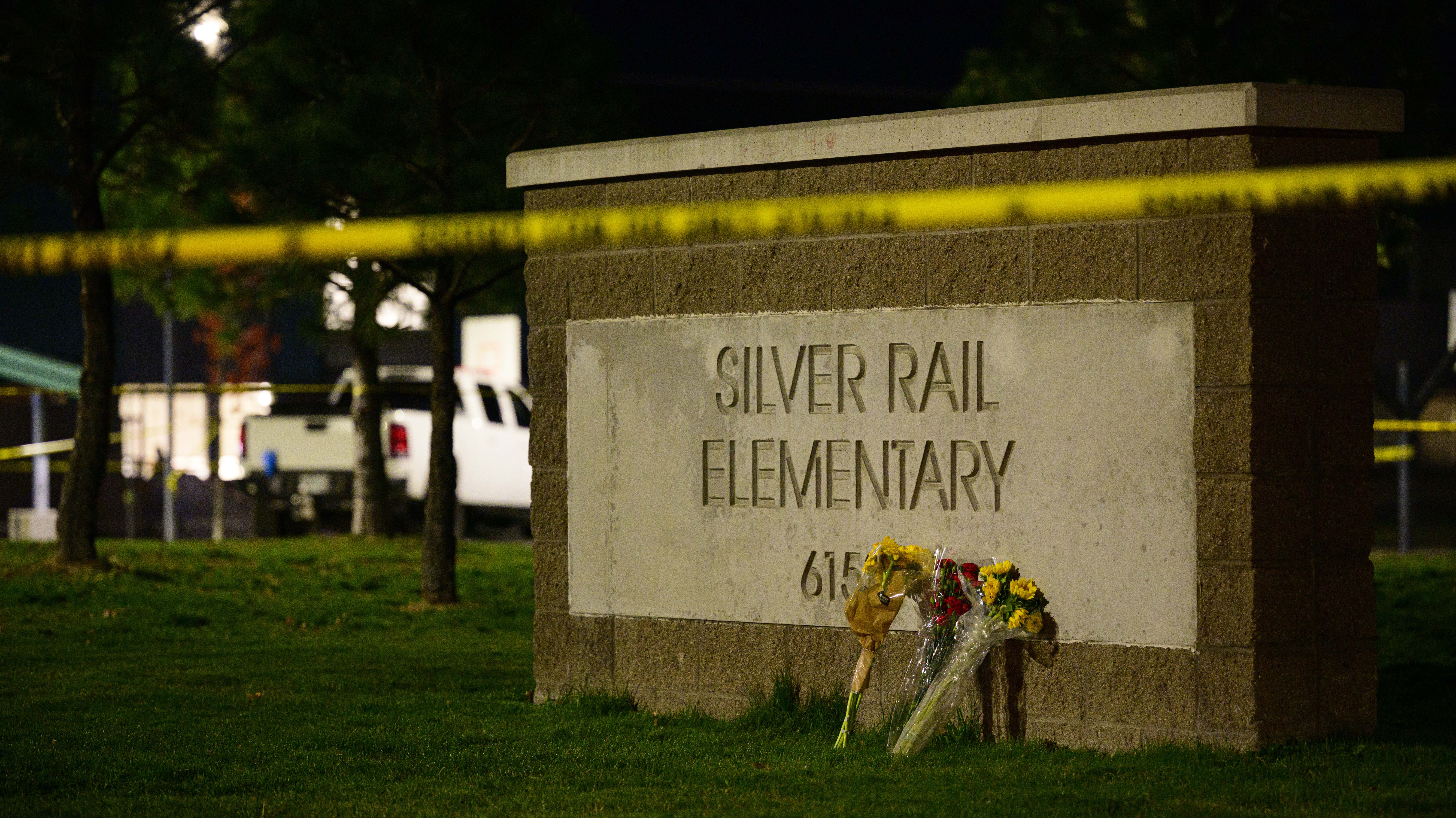
Flowers rest on a sign in front of Silver Rail Elementary School on Oct. 15, 2026, in Bend, Oregon. (Mathieu Lewis-Rolland/Getty Images)
The suspected gunman in an elementary school shooting in Bend, Oregon, was shot by a parent of two students who saw the teen entering the school, his family said on Friday.
Three children and a teacher were killed after a gunman opened fire in Silver Rail Elementary School on Thursday, authorities said. Another student and teacher were injured critically, according to officials.
Police have not yet released any information about the bystander who stopped the suspect, but the hero was identified by family as Kaylub Giamanco.
Giamanco, who has two daughters who attend the school, was driving nearby when he heard the commotion and ran into the school, his family said. The family confirmed that Giamanco has a concealed carry permit.
His family said he is overwhelmed by this and regrets not being able to save more lives.
"Lifelong Bend resident Kaylub Giamanco has come forward as the man who shot and killed the suspect who entered the school. He is not seeking recognition, but instead wishes to express his gratitude to the first responders, school personnel, and community for the outpouring of love and support," the family said in a statement to ABC News.
Oregon Gov. Tina Kotek thanked the community member who she said "heroically intervened to stop further loss of life."
President Donald Trump on Friday praised him as "a great hero" while addressing reporters outside the White House.
"He took care of business, and thank God we had him. Otherwise it would have been much worse," the president said.
Giamanco's family described him as thoughtful and empathetic.
"Kaylub's family, including his two daughters who attend the school, respectfully asks for privacy during this difficult time and will not be participating in interviews," the family said.
ABC News' Nicholas Kerr contributed to this report.
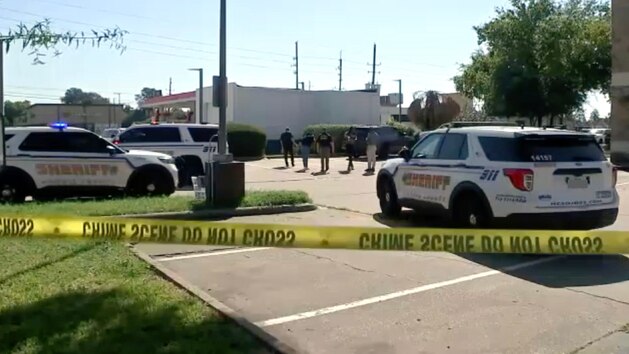
Law enforcement officials are at the scene after a man was struck by a vehicle driven by an ICE agent during chase, according to the Harris Courty Sheriff's Office, on Oct. 10, 2026, in Harris County, Texas. (KTRK)
The Immigrations Customs and Enforcement officer who allegedly struck a man with a vehicle during a pursuit outside Houston last weekend has been placed on administrative leave, the agency said.
The move is standard for all use-of-force incidents, according to an ICE spokesperson.
"This incident is under active internal investigation," the spokesperson said in a statement Friday.
On Saturday, Miguel Parra-Hernandez was hit by a car operated by an ICE agent during an arrest as the unidentified officer attempted to arrest him and another suspect, the agency said. Parra-Hernandez, who ICE alleged is undocumented, is currently in the hospital recovering from injuries to his legs, according to the Harris County District Attorney's office.
Harris County District Attorney Sean Teare said Parra-Hernandez broke his leg in three places and has undergone two surgeries.
Parra-Hernandez has not been charged by any law enforcement agency as of Thursday, according to the DA's office.
ICE said in a statement that that one of its officers was pursuing Jose Mendoza-Cervantes, a Mexican national who they allege had a criminal record and a final order of removal by a judge, and observed him get in a vehicle with Parra-Hernandez Saturday morning.
The ICE officer attempted a car stop, and Mendoza-Cervantes and Parra-Hernandez fled their vehicle on foot, according to ICE and the Harris County Sheriff's Office.
Surveillance video of the incident reviewed by ABC News appears to show the ICE vehicle moving in the direction of a man running and then striking him.
An ICE spokesperson alleged in a statement that Parra-Hernandez "ran in front of an ICE vehicle" when he was hit.
"Allegations that ICE struck Miguel Parra-Hernandez intentionally are RECKLESS and FALSE. The men and women of ICE are entrusted with upholding the rule of law and are held to the highest standards of professionalism, integrity, and ethical conduct," the spokesperson said in a statement Wednesday.
Mendoza-Cervantes remains at large as of Friday, according to ICE.
Teare, the DA, is currently probing the situation and told ABC News Wednesday that his office could possibly pursue criminal charges against the ICE officer.
The DA's office said two people were allegedly detained by the ICE agent prior to the incident and in the back seat of the ICE officer's vehicle when Parra-Hernandez was hit.
Teare told ABC News Thursday that his office was able to interview one of those witnesses before they were deported and that he believes the ICE officer intentionally struck Parra-Hernandez.
"Thankfully, we were able to meet with him in custody yesterday, but we were the only individuals to even speak to him," the DA told ABC News.
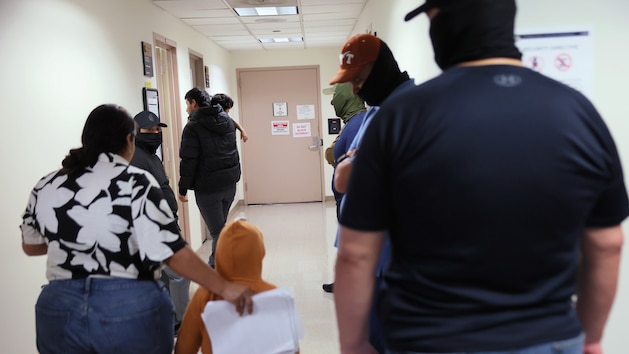
In this Oct. 15, 2025, file photo, a family walks past federal agents as they arrive for their court hearing in immigration court at the Jacob K. Javits Federal Building in New York. (Michael M. Santiago/Getty Images, FILE)
Immigrant advocacy groups representing migrant children have sued the Trump administration to stop what they call a "cruel and unlawful scheme" to fast-track migrant children's asylum cases.
In a complaint filed Thursday night, the groups allege that new government policies have transformed the asylum process for migrant children into a "deportation assembly line depriving them of their rights."
The lawsuit comes as immigration attorneys and advocates say unaccompanied migrant children are being rushed through the immigration system and that their deportations have been accelerated as part of the Trump administration's aggressive immigration crackdown.
"A system that moves faster and that is by design made so that children are unable to access lawyers and are railroaded into deportation orders is not justice. It's assembly line deportation of the most vulnerable among us," said Lindsay Toczylowski, co-founder of the Immigrant Defenders Law Center, during a press call.
The groups said unaccompanied children are facing rushed hearings, difficulty finding lawyers, and accelerated removal orders, including in cases involving alleged human trafficking and threats of violence.
A spokesperson for the Department of Homeland Security did not immediately respond to a request for comment from ABC News.
In the suit, the groups said that U.S. Citizenship and Immigration Services has changed practices through a series of recent policy shifts that include reducing notice times for asylum interviews -- in some cases proving less than 24 hours' notice.
In the complaint, the groups also said that the Department of Justice has instructed immigration judges to complete all removal proceedings for detained unaccompanied children by Jan. 31, 2027. To meet the deadline, the groups allege that immigration judges are refusing to grant continuances of longer than three weeks.
"This push isn't coming from just one agency. It's a coordinated whole-of-government operation that abandons due process and child safety in service of faster removals," said Jason Boyd, vice president for federal policy at the advocacy group Kids in Need of Defense.
The suit comes two days after the Department of Homeland Security announced it was offering unaccompanied migrant children $3,000 to self-deport, a $500 increase over last year's incentive.
Earlier this month, the federal government quietly assembled a team of government attorneys to represent migrant children in court after the administration cut ties with a number of immigration advocacy groups that had previously provided those services.
Immigration advocacy groups have raised concerns about the initiative, arguing that the same government seeking to deport the minors should not be representing them in court.
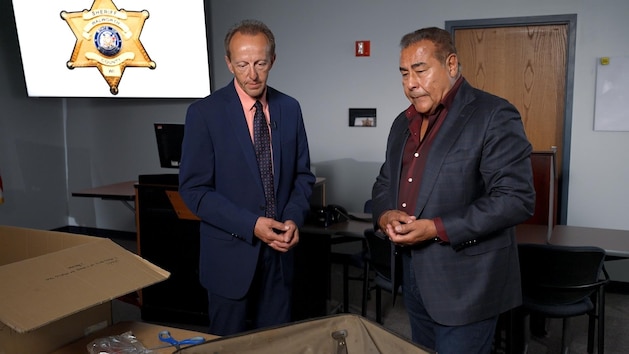
Retired Walworth County Sheriff's Office Detective Jeff Recknagel and "20/20" correspondent John Quiñones examine evidence, including one of the suitcases in which the victims were found. (ABC News)
When human remains were found in suitcases abandoned by the side of a rural Wisconsin road, a community was left shocked and searching for answers.
The first responding officer opened one of the suitcases and discovered a woman's decomposing body -- naked, bound with rope and in a fetal position.
"Nothing can prepare you for what you can see upon opening a suitcase and finding a corpse inside of it," former Town of Geneva Patrol Officer Eric Anderson recalled.
A new "20/20" episode follows the investigation that spanned from Oregon to Minnesota and even involved the FBI. ABC News' John Quiñones reports for "The Suitcase Murders," airing Friday, Oct. 16 at 9 p.m. ET on ABC and streaming the next day on Disney+ and Hulu.
You can get more behind the scenes of each week's episode by listening to "20/20: The After Show" weekly series right on your 20/20 podcast feed on Mondays, hosted by "20/20" co-anchor Deborah Roberts.
When Walworth County Sheriff's Office Detective Jeff Recknagel, now retired, arrived at the scene and opened the second suitcase, he found a black plastic bag with a woman's hand protruding out. Her fingernails were painted pink, and her body was bound with rope and appeared to be in a state of mummification.
Investigators found no identification at the scene, and extreme decomposition prevented them from obtaining DNA from the bodies.
"We had a tremendous amount of work in front of us to try to figure out -- first off, who the victims were, then to try to figure out how they had lost their lives, and then to try to figure out who was the person responsible for that," Recknagel told "20/20."
Police expanded their search beyond Wisconsin. They learned about another case in neighboring Minnesota, where a woman disappeared under suspicious circumstances.
Months before the suitcases were discovered in June 2014, Farmington Police Department Detective Sergeant Lee Hollatz was investigating the disappearance of 37-year-old Laura Simonson.
In November 2013, Simonson, who struggled with mental health issues following the death of her 13-year-old daughter Alyssa earlier that year, abandoned her van in her mother's driveway. Inside were her cell phone, purse, medication, and a note instructing her mother what to do with the vehicle and all her belongings.
Kristin Scouton, Simonson's childhood friend, said she grew concerned because Simonson, who had six other children, would never abandon her family.
"Her kids were her life," Scouton told "20/20." "She would've never just voluntarily left her children."
Detective Hollatz issued a statewide crime alert about Simonson's disappearance. In a stroke of luck, a front desk agent at a hotel about an hour's drive away, reported she recognized Simonson. She remembered that Simonson had stayed at the property several weeks prior with a man that she said made her feel uneasy.
"There's certain people you meet where the hairs on the back of your neck stand up. He was one of those," Kristi Bodunov told "20/20" correspondent John Quiñones.
Although surveillance video of Simonson and this man checking in was unavailable, a registration card with her signature confirmed that she had stayed at the hotel. Police were, however, able to obtain the checkout video that showed the man leaving alone.
As police worked to identify the unknown man, a friend informed detectives that Simonson was involved in an online BDSM dating community and had been communicating with someone with the username, "Mrhandcuffs."
Doing some digging of his own, the friend eventually made a critical discovery that he shared with police. He uncovered Mrhandcuffs' real identity: Steven Zelich.
When Hollatz looked into Zelich's background, he learned something unexpected: Zelich was a former police officer in the Milwaukee area. Hollatz recalled running over to another detective to share the news.
"I go, 'You will not believe this,'" he said. "I'm going, 'Now what am I getting myself into?'"
Zelich resigned in 2001 from the West Allis Police Department following multiple allegations that he had abused his authority to intimidate and harass women. He denied any wrongdoing.
Hollatz asked West Allis police to visit Zelich at his home. But when officers arrived, there were no signs of Simonson.
With promising leads hitting dead ends, the FBI and Wisconsin State Police joined the investigation. In March 2014, the two agencies interviewed Zelich -- he voluntarily provided a DNA sample, but denied ever meeting Simonson.
With no evidence of a crime or foul play, authorities could not move against Zelich, and the case stalled.
Several months later, the discovery of the two suitcases in Wisconsin would crack the case wide open.
Aware of the Simonson case in Minnesota, Wisconsin investigators identified one of the victims as Simonson, in part through a distinctive tattoo on her ankle featuring a heart and her daughter Alyssa's name.
DNA recovered from the rope wrapped around the second victim matched Zelich.
Zelich was brought in for questioning and ultimately arrested. He confessed to killing both women found in the suitcases, identifying the second victim as Jenny Gamez, a 19-year-old from Cottage Grove, Oregon.
He told investigators he met Gamez on the same online dating website where he later met Simonson. He claimed he accidentally strangled Gamez while engaging in "breath play," a sexual activity involving the restriction of breathing.
Zelich said he stored Gamez's body in his refrigerator for over a year before killing Simonson in Rochester, Minnesota, in a similar manner. Maintaining that Simonson's death was also accidental, he described placing her body in the trunk of his car and later moving Gamez there as well.
As the weather warmed, a co-worker mentioned smelling a strong odor coming from near Zelich's car. Zelich said he panicked and decided to dispose of the suitcases.
Ultimately, Zelich was charged with multiple counts of murder and hiding a corpse. He initially pleaded not guilty to all counts.
In 2016, Zelich pled guilty to first-degree reckless homicide in the death of Gamez and one count of hiding a corpse. He was sentenced to 35 years in prison and 10 years of extended supervision.
The following year, he pled guilty to second-degree murder in the death of Simonson and was sentenced to 25 years in prison. He also received an additional 10 years on two counts of hiding a corpse in Walworth County, Wisconsin.
While Zelich's convictions brought the case to a close, Simonson and Gamez's families continued to grapple with their loss.
"Anytime you lose somebody that's so close to you, like your sister, your life's never going to be the same," Gamez's foster sister Amanda Duron told "20/20." "There's always going to be that puzzle where there's always that one missing piece."
Simonson's sister, Niki Carlson, said she keeps her sister's memory close.
"Not a day goes by that I don't think about her. I love her, and I miss her every day." Carlson told Quiñones. "I know they're all looking down on us trying to make sure we're safe."
Three children and one teacher are dead after a shooter forced his way into an elementary school in Oregon on Thursday afternoon and opened fire, authorities said.
The suspected shooter, a 16-year-old, was fatally shot by a community member who saw the teen going into the Silver Rail Elementary School in Bend, Oregon, Bend Police Chief Mike Krantz told reporters at a news conference Thursday evening.
The three children who were killed were 5, 8 and 11 years old.
In addition, a 7-year-old child and a 54-year-old teacher were taken to the hospital with critical injuries, police said.
Police have not publicly identified the suspected shooter saying only that he is a Bend resident. They have not said whether he attended the school or knew anyone at the school.
How the shooting unfolded
The incident began unfolding shortly before 1 p.m. PT Thursday.
At 12:59 p.m., police received a call from a driver who reported being shot at multiple times by a person with a long gun, the police chief said.
Shortly afterward, the Deschutes County dispatch center began receiving multiple 911 calls that a shooter had entered Silver Rail Elementary School.
Krantz said the initial investigation indicates the shooter "forced" his way inside the school by shooting at locked doors.
At 1:01 p.m., the school was directed to go into lockdown, Krantz said.
A minute later, officers arrived on the scene. An officer reported that the suspected shooter had been shot by a community member who had seen the teen entering the school, pursued him and engaged him, Krantz said.
Police have not yet released any information about the bystander who stopped the suspect, but said they would likely share additional information on Friday.
Bystander 'heroically intervened,' governor says
Oregon Gov. Tina Kotek thanked teachers, staff and first responders who rushed to the scene and thanked the community member who she said "heroically intervened to stop further loss of life."
Following the shooting, police said they evacuated the school room by room. A reunification site for families was set up at a nearby church.
Classes, activities and athletic events at all Bend-La Pine Schools are canceled for Friday, school officials said.
Bend-La Pine Schools Superintendent Steven Cook called the shooting an "unthinkable tragedy" and said, "We are heartbroken. We are horrified."
The shooting sparked a large police presence as law enforcement and first responders raced to the gym.
"Everything they were doing seemed highly trained and highly prepared for this," Caleb Weis, who was riding his motorcycle near the school at the time, told ABC News.
"I didn't see as many phones out recording as you see on many other occasions, just a kind of a shock factor and an immense amount of respect for the law enforcement, first responders," he said.
FBI Director Kash Patel said the agency was on the scene assisting in the investigation.
Agents with the Bureau of Alcohol, Tobacco, Firearms and Explosives were also en route to the school, according to a source.
Bend-La Pine Schools Superintendent Steven Cook said they are "stunned and heartbroken by this senseless tragedy."
Classes, activities and athletic events at all Bend-La Pine Schools are canceled for Friday.
Charlotte, North Carolina, USA - March 8 2025 : Side view of a Patrol car used by the Charlotte - Mecklenburg Police department in Charlotte, North Carolina, USA (Onfokus/Getty Images)
Three police officers have resigned amid an investigation into alleged racist texts shared among a group of six officers at the Charlotte-Mecklenburg Police Department (CMPD) in North Carolina, the police chief announced during a press conference on Thursday.
“The allegations against them are serious,” CMPD Police Chief Estella Patterson said during a press conference on Thursday afternoon. “They're deeply troubling. And frankly, I'm disappointed that we're even having to talk about this today.”
Three additional officers are also embroiled in this controversy, and their actions are also being investigated, according to police. Patterson said on Thursday that she supports terminating the remaining three officers who remain on the force.
According to Patterson, the city of Charlotte’s Civil Service Board is reviewing evidence in this case and has the sole authority to determine whether sworn members of the department should be terminated.
The identity of the six officers involved in this case has not been released. Asked about the officers’ identities and the content of the text messages, the CMPD spokesperson did not provide further comment.
According to ABC affiliate in Charlotte, WSOC, the messages included the use of the n-word and were found during an investigation into Flock camera misuse by a former CMPD officer.
Patterson said that since launching the investigation, her department has worked to determine whether there were “external complaints” against the officers being investigated and has partnered with federal agencies to determine whether civil rights violations have occurred.
“We immediately conducted audits of their body-worn footage, we reviewed their traffic stops, their traffic stop data, we looked at their arrest records, and we looked to see if any of those officers had external complaints,” Patterson said on Thursday. “As of this point, we have not found any evidence of this, but I have asked our federal partners to look at the possibility of civil rights violations.”
Patterson said that her department will pursue revoking the North Carolina law enforcement certificates of the officers who resigned so that they cannot serve as law enforcement officers in the state of North Carolina.
“And I hope that they will not be an officer anywhere in this country,” she added.
Patterson said that she is “concerned whether this type of behavior is systemic” and said that her department is taking steps to ensure “proper conduct.” She also said that the state of North Carolina requires officers to participate in “ethics training.”
“My message to the community is that I have said from day one and coming in this position that we will hold employees accountable that are not doing their jobs properly, that operate outside the law, procedures, policies, or anything that's ethical or unethical within the organization,” Patterson said.
“While I have focused on the negative actions of a few, and we will hold any other employee to proper conduct, I want to underscore the point that the overwhelming majority of our employees do exceptional work every single day,” she added. “They come to work to serve this community, and they demonstrate that in their actions. They do their work with respect, with compassion, and professionalism.”
A spokesperson for CMPD told ABC News in a statement on Tuesday that the department “will not tolerate any behavior that contradicts our core values or jeopardizes the trust we have built with the community we serve.”
Rev. Corine Mack, who leads the Charlotte-Mecklenburg chapter of the NAACP, told ABC News on Tuesday that she was “not surprised” but was "disturbed" by the alleged conduct that is being investigated in this case. “I'm hoping that every one of the officers involved gets decertified, so they cannot go into another department and do further harm to people of color, specifically Black people,” she said.
ABC News' Sabina Ghebremedhin contributed to this report.
Michelle Parker vanished in 2011 after appearing in a pre-taped episode of the reality show "The People's Court" with her former fiance over a dispute about her engagement ring, according to police.
Nearly 15 years after the 33-year-old Florida mother of three was reported missing, Parker's ex-fiance has been arrested for her murder, police announced this week.
Dale Smith Jr., 55, was taken into custody at his business Wednesday on a charge of second-degree murder, Orlando police said.
"While Michelle has not yet been located, all evidence leads to Dale Smith Jr. as the person responsible for Michelle's murder," Orlando police said.
Smith, who had previously been named a suspect in the case, was the last known person to see or hear from Parker after she dropped off their two children at his house in November 2011, according to police.
Over the past year, investigators "reexamined testimony and conflicting statements made by the suspect and used advanced digital forensics to uncover and analyze additional evidence," Orlando Police Chief Eric Smith said during a press briefing Wednesday.
The police chief did not go into specific details on the investigation, saying he did not want to compromise the prosecution, though he credited advances in technology with helping lead to an arrest.
"The things we couldn't do 15 years ago that we can do now allowed us to close this case," the chief said.
Orlando Police Detective Phillip McMican told reporters that new evidence was found using advancements in digital forensics, including vehicles, electronic devices, phones and computers.
Regarding Smith's statements, the detective said that "very specific questions were asked of him numerous times over the years, where he gave different answers to those same questions."
Smith has entered a not guilty plea to the charge, according to a court filing.
He remains held without bond following his initial court appearance on Thursday.
During the hearing, his attorney, Rajan Joshi, had asked for bond, arguing that the allegations in the 46-page affidavit failed to meet the high standard to deny pretrial bond, while the state asked that he remain in custody.
The arrest warrant and affidavit in the case have been sealed.
Smith has maintained his innocence since Parker's disappearance, his attorney told ABC News.
"When he was originally questioned, when this initially happened, he was very cooperative with law enforcement. He let them search his house. He talked to them. He came in voluntarily without a lawyer, gave an interview," Joshi said. "It was clear that law enforcement was only looking at him as the sole suspect. That's when his friends urged him to get an attorney, and that's when he contacted me. This is 15 years ago."
Joshi said they are focused on filing a bond motion and working to get Smith released.
State Attorney Monique Worrell said during Wednesday's press briefing that the second-degree murder charge could be upgraded if supported by the evidence.
Parker was last seen on Nov. 17, 2011, when she dropped off their 3-year-old twins at Smith's house, police said. Her car was found the following day with the decal for her tanning business scraped off the window, and her cellphone was recovered from a lake south of Orlando, according to police.
She disappeared after an episode of "The People's Court" featuring her and Smith had aired, police said. Smith was seeking $5,000 over a lost engagement ring, saying in the episode that Parker had thrown the ring at him during an argument at an Atlanta hotel and it went over a balcony.
During the episode, the exes discussed their on-again, off-again relationship and contentious co-parenting situation for their twins. Parker, who had an older child from a prior relationship, described Smith as "pretty malicious and vindictive," saying, "He's a mean person, especially when he's been drinking."
The show's judge, Marilyn Milian, found both were at fault and that Parker owed Smith $2,500 for her half of the ring.
President Donald Trump arrives to speak during a luncheon in the Rose Garden of the White House, Oct. 15, 2026, in Washington. (Kevin Dietsch/Getty Images)
Nine former FBI agents who investigated President Donald Trump and his alleged mishandling of classified documents after he left office following his first term filed suit against the FBI and Justice Department on Thursday alleging they were unlawfully terminated solely for their role in the probe.
The nine agents, who in the suit say they collectively count "over a century" of experience in the bureau on cases spanning from the Boston Marathon bombing to the first assassination attempt targeting President Trump, say they were all fired over the course of two days in February this year by FBI Director Kash Patel.
"Plaintiffs were unlawfully terminated not for any cause or any legitimate reason, but only to satisfy the President's personal vendetta," said attorney Abbe Lowell in the lawsuit filed Thursday in D.C. District court. "The firings did not follow any internal investigation or disciplinary process within the FBI, and Plaintiffs were not given any notice, a hearing, or an opportunity to appeal."
The lawsuit, which seeks to have the agents' employment reinstated, points to public statements from Patel and Attorney General Todd Blanche, who the agents claim smeared their character by defending the firings.
"For example, a month after Plaintiffs' unlawful firings, Blanche stated that the Administration had 'cleaned house' at the FBI by firing anyone associated with investigations relating to Trump, and that there 'isn't a single man or woman with a gun, federal agent, still in that organization that had anything to do with the prosecution of President Trump,'" the suit claims.
The agents also argue that the firings may have endangered active counterintelligence and terrorism cases that some of the agents were involved in when they were terminated.
"As a result of their unlawful and hasty firings, Plaintiffs' investigations were not properly transferred to other FBI Special Agents or Analysts," the lawsuit says. "The impact of these heedless actions on America's national security is immeasurable."
Each of the agents contend in the lawsuit that none volunteered for their assignment on the classified documents case against President Trump that resulted in his indictment on 42 counts of unlawfully retaining classified records after leaving the White House in 2021. Prosecutors said he repeatedly refused to return hundreds of documents containing classified information and took steps to thwart the government's efforts to retrieve them.
Trump, who pleaded not guilty to all charges, has long denied any wrongdoing, and the federal judge who oversaw the case ultimately dismissed it on the grounds that special counsel Jack Smith, who led the probe, was not lawfully appointed to his position.
In a statement responding to ABC News' inquiry about the lawsuit, a DOJ spokesperson said the department "is committed to treating employees fairly and complying with the law, and will continue to defend the President's authority to support and defend the nation."
"Central to his Constitutional authority, the President is not required to delineate cause for federal employees who are removed," the spokesperson said. "To establish a standard of review would subject Presidential power to the whims of an outside agency or another branch of government, which is inappropriate."
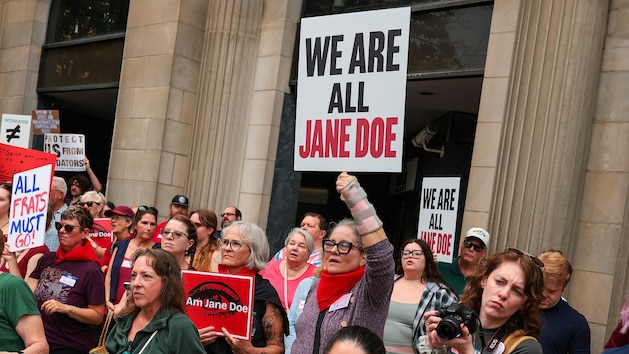
Protesters listen to speakers at a rally in support of a former Cornell University student known as Jane Doe at the Ithaca Commons, October 13, 2026 in Ithaca, New York. (Anna Moneymaker/Getty Images)
A meeting of Cornell University's faculty senate grew heated Wednesday as school president Michael Kotlikoff faced harsh questions about the Ivy League school's response to the alleged 2024 gang rape of a student at a fraternity house, according to an audio recording of the meeting.
Kotlikoff defended the school's recent measures -- including suspending fraternity parties and involving state police in the investigation of sexual assaults on campus -- but was repeatedly grilled by faculty members about the university's response.
The meeting was the first of two at which the faculty senate will consider a no-confidence resolution to condemn the school's response to sexual violence on campus. A vote on the resolution is expected at the end of the month.
"This is a systemic problem that deserves systemic attention, and thus far, President Kotlikoff, it appears that you have simply reacted to pressure," Professor Risa Lieberwitz said at Wednesday's meeting, according to the recording. "It feels that the administration is considering more about how do we respond to pressure rather than the kind of leadership which should have been doing systemic work and prioritizing these issues all along."
"I understand that people feel like this is reactive," Kotlikoff responded. "I felt hearing about this, having much of this information come through for the first time, we ought to take some time."
A then-undergraduate student identified only as Jane Doe made a complaint to campus police in November 2024, three weeks after the incident occurred, that she had been raped by a group of men at the Chi Phi fraternity house. She has filed a civil suit against the men and the university alleging that she had been drugged and raped.
New York Attorney General Letitia James is conducting an investigation into the incident, and Cornell is also conducting an internal probe of its response to the allegations.
All seven fraternity brothers named in the civil lawsuit have denied wrongdoing and no criminal charges have been filed in the case.
At Wednesday's meeting, faculty member Noah Tamarkin questioned Kotlikoff about why two of the students allegedly involved in the incident were still allowed to continue their education on campus.
"We've heard repeatedly from our students, both undergraduate and graduate, as well as our colleagues and other staff, that they don't feel safe with these men on campus," said Tamarkin. "Can you explain what is going on with this and speak directly to this problem of what a temporary suspension is meant to do if a student is found liable for rape?"
Kotlikoff defended the Title IX investigation that was launched following the alleged assault, and noted that Cornell, by law, could not release many of the details about the process. He also noted that those men were not found responsible for rape, according to the Title IX investigation.
"That is due process in the way our process works," he said. "You may disagree with the outcome, I may disagree with the outcomes, but that is our process."
Andrew Moisey, an associate professor, also raised concerns about the reputational harm that Cornell suffered because of the incident.
"It feels like to me ... that Cornell's been in an abusive relationship with fraternities," he said.
"I really appreciate the sentiment of a lot of faculty and a lot of leadership of the university that has said to me, 'It's time for Greek life to go,'" Kotlikoff said. "I just think we have to all take a step and carefully study this issue. If, at the end of the day, fraternities cannot exist in a safe environment and we can't be convinced that they can be safe, then we should make that decision."
Kotlikoff began his remarks by addressing the recent decision to suspend fraternity parties, arguing it was a necessary step to counter what he described as the Greek system's "monopoly of social activity for students."
"Much of the social activity occurs in private houses," Kotlikoff said. "We don't have full ability to be confident that what goes on in those houses is safe."
President Nicolas Maduro gives a press conference after testifying before the Supreme Court of Justice on Aug. 2, 2024, in Caracas, Venezuela. (Jesus Vargas/Getty Images)
Ousted Venezuelan leader Nicolas Maduro and his wife, Cilia Flores, each pleaded not guilty Thursday to new charges accusing them of torturing people, including Americans, to help them cling to power.
Maduro, in a beige jail smock over a brown T-shirt and wearing glasses, greeted the audience with a wave and shook hands with his attorneys.
Asked how he pleaded to the charges contained in a superseding indictment, Maduro responded, "I reject this document in its entirety" and called the accusations of torture "false."
Maduro and his wife are scheduled to stand trial on June 14, 2027.
Federal prosecutors accused Maduro of conspiring with his wife to torture individuals who were held in Venezuelan prisons, according to a criminal indictment unsealed last week.
The indictment accused his government of torturing Americans because Maduro "assigned blame to the United States for the instability in Venezuela."
Federal prosecutors alleged Maduro "presided over this system of repression and torture" and his wife, Cilia Flores, is accused of helping him develop it.
"When Maduro became President of Venezuela in or about 2013, he authorized the use of torture against specific individuals and oversaw a system designed to use torture, military detention, and violence as a means of repression against the political opposition," the indictment alleged.
Maduro was charged by superseding indictment with one count of conspiracy to commit torture and Flores was charged with one count of conspiracy to commit torture and one count of narcoterrorism.
Both previously pleaded not guilty to narcoterrorism and drug trafficking charges and maintained their innocence during their first court appearance in January, following their capture by U.S. forces in a military operation in the Venezuelan capital of Caracas.
Maduro's lawyer argued in a court filing last month that the former president is immune from prosecution because he was the leader of a sovereign nation.
In this aerial view, the train of the Goliath roller coaster is seen on the track where it was evacuated at Six Flags over Georgia on Oct. 14, 2026, in Austell, Georgia. (Elijah Nouvelage/Getty Images)
The most recent inspection of Six Flags Over Georgia's Goliath roller coaster found no violations or deficiencies, the office responsible for the safety of amusement park rides in Georgia said Thursday, days after a man fatally fell from the ride.
"No violations, deficiencies, citations, or red tags were reported" during the March 16 inspection, the Office of the Commissioner of Insurance and Safety Fire (OCI) in Georgia said in a statement.
ABC News has obtained the last three Goliath state inspection records, which confirm the ride passed inspection each year since 2024.
The Goliath roller coaster was taken out of service and "remains secured" amid the state's investigation into Monday's deadly incident, OCI said. Investigators and engineers are on site conducting an "in-depth examination of the ride, its operation, and records to determine the circumstances surrounding the tragedy and whether all applicable state safety requirements were followed," OCI said.
Georgia Insurance and Safety Fire Commissioner John King said his department is conducting the investigation "with the urgency, diligence, and unwavering commitment to public safety that this tragedy demands."
"This is not an investigation in which we will cut corners, rush to conclusions, or leave questions unanswered without making every effort to resolve them," he said in a statement.
OCI said it will share its findings once the investigation is complete and "determine what further actions may be necessary under Georgia law."
The Goliath roller coaster will remain closed until the state's investigation is complete, OCI said, noting that it will "determine when, and under what conditions, the ride may be permitted to resume operation."
Hassan Jihad Ibn Kariem, 42, of Atlanta, was found dead after being "ejected" from the ride Monday afternoon, according to the Cobb County Police Department.
"Preliminary information gathered through witness and employee interviews indicates Kariem was ejected from the ride and struck other patrons before falling beneath the attraction," the Cobb County Police Department, which is also investigating the incident, said in a statement Tuesday.
The victim was found on a building inside the park and had "sustained fatal injuries," according to a Cobb County Police incident report.
Four children were injured in the incident, police said. They were all transported by ambulance to local hospitals with non-life-threatening injuries, Cobb County Police said Wednesday, noting that no additional details are being released because they are minors.
Kariem was at the Six Flags park with several family members to celebrate his niece's birthday and was sitting beside his niece when he was ejected from the roller coaster, a relative told ABC News.
He worked for the Atlanta Public Schools and was a "cherished member" at Wesley International Academy, the school district said. He was the IT manager, a technology teacher and robotics coach at the school, where he had worked for over 12 years, Wesley International Academy said.
A Six Flags spokesperson said that the "park team and local authorities responded immediately, and we are cooperating fully with local authorities as they complete their investigation."
"We are deeply saddened by the guest incident at our park today," the spokesperson said in a statement on Monday. "Our thoughts and heartfelt condolences are with the guest's family, friends, and loved ones. We are also providing support to the guests and team members affected."
The Goliath roller coaster reaches an elevation of 200 feet and speeds up to 70 mph, according to the amusement park's website. The ride first opened in 2006 at the amusement park, located west of Atlanta in Austell.
The Six Flags spokesperson said that "out of an abundance of caution," the theme park company has "temporarily closed similar attractions across our parks."
In addition to the Goliath roller coaster at Six Flags Over Georgia, nine similar hypercoasters in six theme parks across North America are temporarily closed.
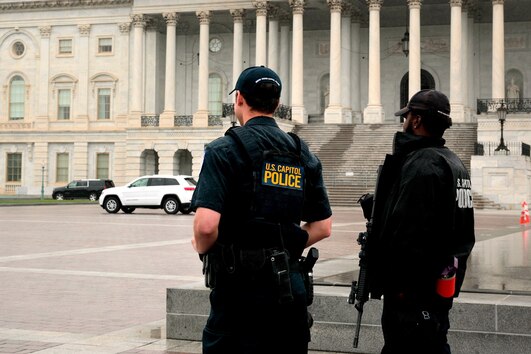
In this June 16, 2025, file photo, U.S. Capitol Police Officers stand guard outside of the U.S. Capitol Building in Washington, D.C. (Anna Moneymaker/Getty Images, FILE)
The FBI, U.S. Capitol Police and U.S. Postal Inspection Service are investigating "multiple letters containing suspicious substances that were mailed to various addresses nationwide, including multiple Congressional offices," according to a notice sent to Senate staff on Thursday and described to ABC News.
Investigators didn't immediately disclose more details of the suspicious substances.
Federal law enforcement officers are working to intercept the letters, according to the notice.
The Senate Sargent at Arms warned in the notice that some letters could make it to congressional offices.
The Senate Sargent at Arms recommended treating any suspicious letters with caution, and that suspicious letters contain multiple postage markings, according to the notice.
The Capitol Police referred ABC News to the FBI for comment.
The FBI confirmed in a statement Thursday that it was working with the U.S. Postal Inspection Service in a probe over "a series of suspicious mailings sent to various addresses nationwide, including Secretary of State offices and their related election offices."
Those mailings also "contained an unknown substance," according to the FBI.
"We are also working with our partners to identify the individual or individuals responsible for the letters. The FBI and the U.S. Postal Inspection Service will continue to safeguard the public and secure elections for American citizens," the FBI said in a statement.
It is unclear whether these letters are connected to the letters recently sent to Secretaries of State's offices around the country.
The largest Hindu temple near Aurora, Illinois, is believed to have been the target of a thwarted mass shooting plot allegedly planned by Alexandros Paporakis, authorities said. (WLS)
A 19-year-old Illinois man has been charged after an investigation into an alleged plan to carry out a mass shooting that may have targeted a Hindu place of worship in the Aurora area, police said.
Alexandros Paporakis of Palatine was arrested Sunday after the Palatine Police Department received information from the Mount Prospect Police Department about a potential mass shooting, according to a statement from Palatine police.
The information came from an individual who reported receiving "concerning electronic communications" from Paporakis, police said.
Authorities said Paporakis had shared a document allegedly outlining a plan for a mass shooting, along with images depicting a rifle, rifle magazines, body armor and other tactical equipment.
Officers from the Palatine and Mount Prospect police departments coordinated a response and took Paporakis into custody as he was leaving his residence in Palatine on Sunday evening, police said.
Authorities said they recovered a rifle, multiple loaded rifle magazines, hundreds of additional rounds of rifle ammunition, tactical equipment and other items during a search of his home after his arrest.
Investigators said that they also recovered a tactical vest containing body armor and a patch displaying imagery associated with white supremacist extremism.
In the days following his arrest, detectives reviewed electronic communications and examined a document attributed to Paporakis titled, "Why I Fought: A.K.A.: (Aurora Shooter's Manifesto)," which contained statements expressing white supremacist and extremist ideologies, including references to violence against people of South Asian heritage, particularly those of Indian descent, police said.
Based on information gathered during the investigation, detectives said they believe Paporakis may have been planning an attack on Oct. 11 that potentially targeted a Hindu place of worship in the Aurora area, though police said the specific intended location has not been confirmed and remained under investigation.
The Aurora Police Department was notified of the potential threat by Palatine and Mount Prospect police. Aurora police subsequently contacted Hindu places of worship in their jurisdiction to make them aware of the information, authorities said.
"The seriousness of this alleged threat cannot be overstated," Palatine Police Chief William Nord said in a statement, crediting the coordinated response by Palatine and Mount Prospect police with helping officers identify and take the suspect into custody. He also thanked the person who initially reported the information and the FBI for its assistance.
Paporakis has been charged with one count of making a terrorist threat, a class X felony, and one count of unlawful possession of a rifle with a barrel shorter than 16 inches, a class 3 felony, police said.
Paporakis appeared at a detention hearing Wednesday at the Cook County Third Municipal District Courthouse in Rolling Meadows, where a judge ordered him detained.
"The FBI aggressively works alongside our local and state law enforcement partners to identify, investigate, and dismantle any threats of violence driven by radical ideologies," FBI Chicago Special Agent in Charge Ryan Whalen said following the charging announcement by the Cook County State's Attorney's Office.
"Thanks to the swift action by the Palatine and Mount Prospect Police Departments, the subject was taken into custody without harm to our community," Whalen continued. "The FBI values these strong partnerships and will continue to use every law enforcement and prosecutorial resource available to bring any offender using fear or violence to justice."
Palatine police said that they are continuing to work closely with the FBI and that investigation remains active. Additionally, authorities have not identified any known ongoing threat to the public associated with this incident.
Paporakis’s next court appearance is set for Oct. 30 at 9 a.m. ET.
Protesters listen to speakers at a rally in support of a former Cornell University student known as Jane Doe at the Ithaca Commons, October 13, 2026 in Ithaca, New York. (Anna Moneymaker/Getty Images)
The Cornell professor who introduced a no-confidence resolution condemning the school's leadership lambasted what he described as a "culture of fear" at the Ivy League school during Wednesday's faculty senate meeting, according to a copy of his remarks reviewed by ABC News.
During the closed-door meeting, Paul Ortiz, a professor of labor history, criticized Cornell leadership for treating "rape as a 'PR problem,' rather than a heinous crime."
"Most of the current and former students who have approached faculty to share their stories of being sexually assaulted at Cornell told have told us they were afraid to report these assaults because they felt that Cornell has often treated rape as a 'PR problem,' rather than a heinous crime," Ortiz said, according to the remarks. "This administration and previous administrations have created a climate or culture of fear that prevents many victims of sexual assault from coming forward to testify about being assaulted."
The meeting Wednesday comes a month after allegations of a "gang rape" at a campus fraternity shook the Ivy League school.
A then-undergraduate student identified only as Jane Doe made a complaint to campus police in November 2024, three weeks after the incident occurred, that she had been raped by a group of men at the Chi Phi fraternity house. Last month, she filed a civil suit against the men and the university alleging that she had been drugged and raped.
No criminal charges have been filed in the case, but an investigation by the New York attorney general is ongoing. All seven fraternity brothers named in the civil lawsuit have denied wrongdoing.
Faculty senators inside the room on Wednesday described a "heated debate" over the resolution, though the bulk of speakers appeared in favor of the resolution.
Ortiz argued that "many students do not come forward because they understand that their ordeals will not be treated seriously by Cornell," and urged his fellow faculty senators to hold the school's leadership responsible.
"This administration has chronically failed to address these core issues at the bottom of the Jane Doe case as well as hundreds of other untold stories of sexual assault and trauma at this university. This is the primary rationale for this resolution," he said, according to the remarks.
The one-sentence resolution being debated reads: "The Faculty Senate has no confidence in the ability of the central administration to effectively address the ongoing crisis of sexual assault at Cornell University."
The resolution itself does not call for specific action -- such as demanding resignations or forcing policy changes -- and instead offers a broad condemnation of the school's response.
While Ortiz applauded recent changes announced by Cornell leadership to address sexual violence on campus, he argued that the changes were too little too late.
"For years, faculty who have expertise in the issues at hand ranging from student disciplinary procedures to mental health have begged this administration to let us help with these issues. Instead, we have been stonewalled by Cornell's increasingly top-down leadership. That the administration waited until the day before they might be held accountable in the faculty senate meeting today is appalling," he said.
Cornell President Michael Kotlikoff addressed the faculty senate toward the beginning of the meeting to defend the school's recent measures addressing sexual assaults on campus.
Ahead of the meeting Wednesday Kotlikoff announced additional measures to "strengthen campus safety, better support survivors, and begin addressing the social context of sexual violence at Cornell."
The school vowed to add more staff to its Office of Civil Rights -- which conducts Title IX investigations -- as well as report allegations of sexual assault to the New York State Police during the school's review of its policies.
In a video released earlier this month, Kotlikoff said the university "must do better" calling it a "defining moment" for the university and pledging to take "every step necessary to make Cornell an institution that leads not just in what we say about these issues, but in the work we do to address them."
Debate on the resolution is scheduled to continue during the faculty senate's next meeting on Oct 28. Voting will take place during the five days following that meeting.
Cornell's faculty senate is a "governing body that supports faculty communication toward successful management of objectives for the University," according to the school. Academic titleholders at Cornell -- including professors, senior lecturers, librarians, archivists and others -- are eligible to be senators, who serve three-year terms.
Oscar Belgal was shot Thursday in his car while his 5-year-old son was in the back seat, authorities said. Attorneys with the Legal Aid Society said in a habeas petition that the bullet is still "lodged in his neck" and he is only being given ibuprofen for the pain.
"With the bullet still lodged in his neck, the entire left side of Oscar's face remains numb. He struggles to hear anything out of his left ear, describing what he does hear as sounding as if it were far off in the distance," the petition said.
The 28-year-old Dominican national is allegedly being held in a segregated unit at the Metropolitan Detention Center in Brooklyn, as federal prosecutors seek to remove him from the country, according to the petition.
A federal judge on Wednesday temporarily barred the Trump administration from deporting Belgal or transferring him outside of the Southern District of New York, the Eastern District of New York or the District of New Jersey. A different judge ordered a similar block on Belgal's deportation last week.
In his order Wednesday, U.S. District Judge Hector Gonzalez is also asking the government to explain why it believes Belgal warrants mandatory detention despite recent rulings, including one by the same judge, that limits the government’s ability to detain someone without bond or consideration of their individual circumstances.
Belgal's attorneys contended ICE agents arrested Belgal without a warrant.
ICE did not immediately comment on the latest court filing from Belgal's attorneys.
Last week, the Department of Homeland Security alleged that Belgal, who they claim has "associations" with a gang and a criminal record, "weaponized his vehicle," when ICE agents tried to box him in with their vehicles during the arrest. Belgal denies having involvement with the gang and his attorneys say ICE has not provided any evidence?
Surveillance footage shows Belgal parked in his SUV when two officers in plainclothes approach him with guns drawn.
It is not immediately clear what the two armed men were saying to Belgal.
Belgal is seen reversing and then driving out of the parking spot as one of the armed men punches the driver's side window and breaks the glass. He is seen driving off.
In their petition, Belgal's attorneys provided more details about what they claim happened during that confrontation. They said their client had picked up his 5-year-old son from school Thursday afternoon and then took him to a McDonald's for an after-school snack.
When they arrived home, Belgal noticed he was parking in front of a hydrant and started to back up before pulling forward, the petition said.
It was at that moment that a "masked man stormed" his driver-side window with his weapon drawn, and other masked agents surrounded the vehicle, the petition said.
"[W]ithout identifying himself, the first man struck and shattered Oscar's window and began firing a pistol into Oscar's car while his son cowered in the back seat," the petition said.
The shooting sparked outrage from many New Yorkers and elected officials, including Mayor Zohran Mamdani who called on the federal government to remove ICE from the city.
DHS Secretary Markwayne Mullin pushed back against Mamdani during a news conference Friday and slammed the city's sanctuary cities policies.




.png)